
The best mop for commercial floors depends almost entirely on the floor surface and the type of soil you are dealing with — there is no single winner. String mops absorb more and cover large rough areas fast; flat and microfibre systems clean more hygienically, protect delicate surfaces, and are far easier to manage in a structured housekeeping programme. Most professional operations benefit from keeping both in service rather than choosing one over the other.
Cotton (Kentucky) vs Acrylic vs Microfibre: What Is Actually Different?
The fibre type determines how a mop absorbs, releases, and survives repeated washing — and the differences are significant in daily commercial use.
- Cotton Kentucky string mops are heavy, highly absorbent, and built for rough or uneven surfaces such as loading docks, kitchens with quarry tiles, or outdoor paved areas. They hold a large volume of water and diluted chemical, making them efficient for mopping wide spans quickly. The trade-off is weight when wet, the effort required to wring them thoroughly, and a tendency to leave moisture behind — a real concern on marble or wood. Cotton mops are durable but can deteriorate faster if dried poorly or stored damp.
- Acrylic string mops use synthetic fibres that are lighter than cotton, dry faster, and resist bacterial growth better. They absorb somewhat less than cotton but release solution more evenly. Acrylic is a practical upgrade from cotton for general corridor and back-of-house work where you want the familiar string-mop motion but with easier maintenance.
- Microfibre mops — whether in flat-pad or looped-string form — work on a different principle. The fibres are split at the microscopic level, creating physical pathways that trap and lift particles rather than simply pushing them. This makes microfibre genuinely more effective at removing fine dust, allergens, and bacteria from smooth surfaces. The result is a cleaner floor with less chemical, less water, and less physical effort. In a rigorous commercial laundry programme, quality microfibre pads can withstand hundreds of wash cycles.
On longevity: acrylic and microfibre both outlast cotton in most hotel or restaurant environments where mops are laundered daily. The key variable is wash temperature — microfibre degrades rapidly above 60°C, so staff training on laundry protocols matters as much as the product itself.
Why Some Housekeeping Directors Still Prefer String Mops on Marble and Hardwood
The preference usually comes down to familiarity and the fear of scratching — but on polished marble or sealed hardwood, a well-used string mop is actually more likely to cause harm than a microfibre flat pad. String mops, especially when grit is trapped in the fibres, drag abrasive particles across a polished surface. They also deposit more water, and standing moisture is the primary enemy of both natural stone and wood.
Directors who have switched to flat microfibre systems on their marble corridors consistently report that floors stay cleaner between deep cleans, polishing cycles are needed less often, and wet-floor incidents drop because the floor dries faster. The reluctance to change is understandable — string mops are forgiving of technique, while a flat-mop system requires consistent pad changes and colour-coding discipline to deliver its benefits. The system works; the investment is in training, not the tool itself.
Does a Flat Mop Absorb as Much as a String Mop? When Do You Still Need a String Mop?
A flat mop does not match a heavy Kentucky string mop on raw absorption — that is not what it is designed for. A flat pad holds enough solution for regular damp-mopping and handles minor spills efficiently, but for a large liquid spill — a dropped bucket, a flooded prep area, a plumbing incident — a string mop or a dedicated wet-vacuum is the faster tool.
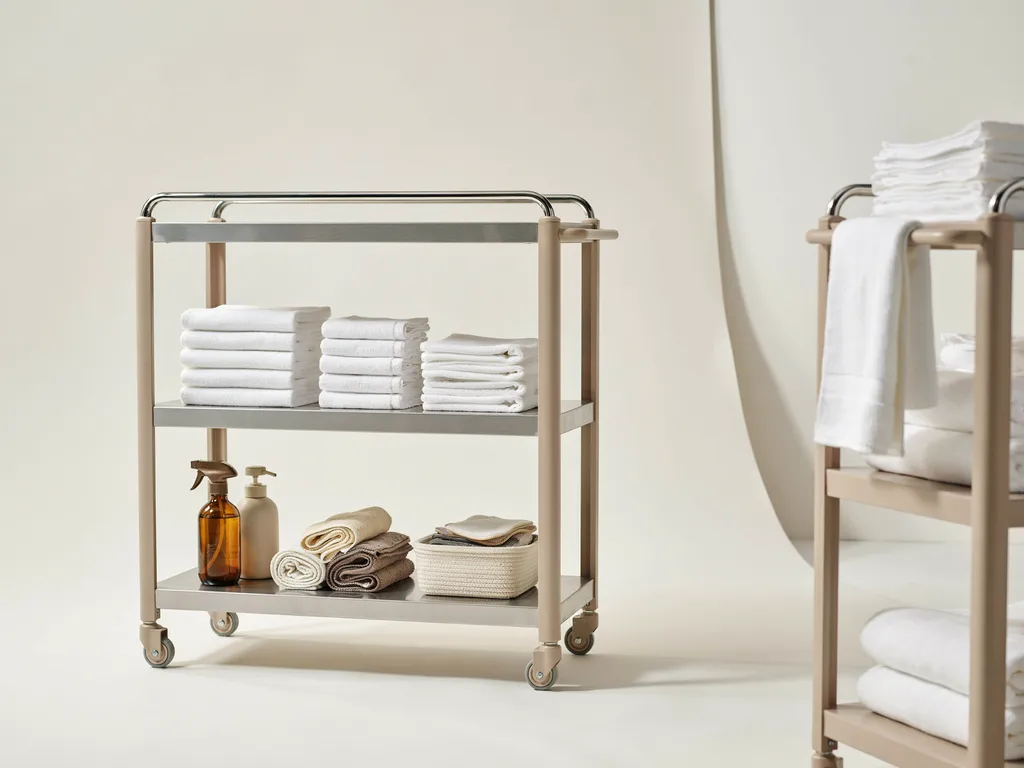
In practice, most hotels and restaurants should run both systems in parallel: flat microfibre pads for the daily cleaning pass on guest-facing floors, and a string mop (cotton or acrylic) available in the housekeeping trolley or back-of-house for reactive spill response. Trying to force a flat-mop pad to soak up a major spill wastes pads and time.
Can You Use the Same Microfibre Pad for Bathrooms and General Floors?
No — and this is one of the most important protocols in a professional housekeeping operation. Bathroom floors carry a microbial load that is categorically different from corridor or restaurant floors. Using the same pad transfers contamination even after rinsing, because microfibre fibres trap particles that a quick rinse does not fully release.
The correct approach is colour-coded pads: one colour dedicated to bathrooms and wet areas, a separate colour for dry general floors, and optionally a third for food-preparation or kitchen zones. This is standard practice in healthcare and is increasingly expected in hotels rated three stars and above. The extra pad cost is negligible against the hygiene and liability benefit. Pads should be bagged separately after use and laundered in labelled batches to prevent cross-contamination in the laundry room as well.
The Case for a Flat-Lamellar Mop System in a Hotel: Is the Investment Worth It?
For a hotel with marble corridors, tiled room floors, and polished lobby surfaces, a flat-mop system is worth the switch — and the ROI is measurable in operational terms rather than just hygiene. The calculation runs roughly as follows: flat pads cover the same area as a string mop in fewer passes because the full face of the pad is in contact with the floor throughout the stroke. Staff fatigue is lower. Chemical usage drops because microfibre requires less solution to clean effectively. Floors dry faster, reducing slip risk and allowing corridors to return to guest use sooner.
Lamellar and flat-mop frames in 45 cm, 60 cm, 80 cm and 100 cm widths allow housekeeping managers to match the tool to the space — a 45 cm frame for rooms and bathrooms, an 80 or 100 cm frame for wide corridors or banquet floors. The wider frames cover significantly more area per stroke and make a genuine difference in staff productivity over an eight-hour shift.
The upfront cost of frames, handles, and a sufficient pad inventory is higher than replacing a Kentucky mop refill. Over a six-month cycle, the savings on chemical, reduced floor-maintenance frequency on polished surfaces, and lower staff turnover from reduced physical strain typically more than offset the initial outlay. For a property that takes floor care seriously, it is not a luxury upgrade — it is the operationally correct choice.
What SGS Stocks and How to Order
SGS Sales carries cotton and acrylic string mop refills, microfibre flat pads, and complete flat-mop systems from Dustie, Kent, and Lamellar in 45 cm, 60 cm, 80 cm, and 100 cm widths. Colour-coded microfibre pad sets are available for properties implementing zone-based hygiene protocols. All items are available for direct delivery across Uttar Pradesh and Uttarakhand through our own fleet.
Browse the full range in Cleaning Tools, or speak with our team about specifying the right system for your property. Hotels and resorts can also explore our broader hotel supply programme, which covers housekeeping consumables, amenities, paper goods, and F&B supplies under one account.